
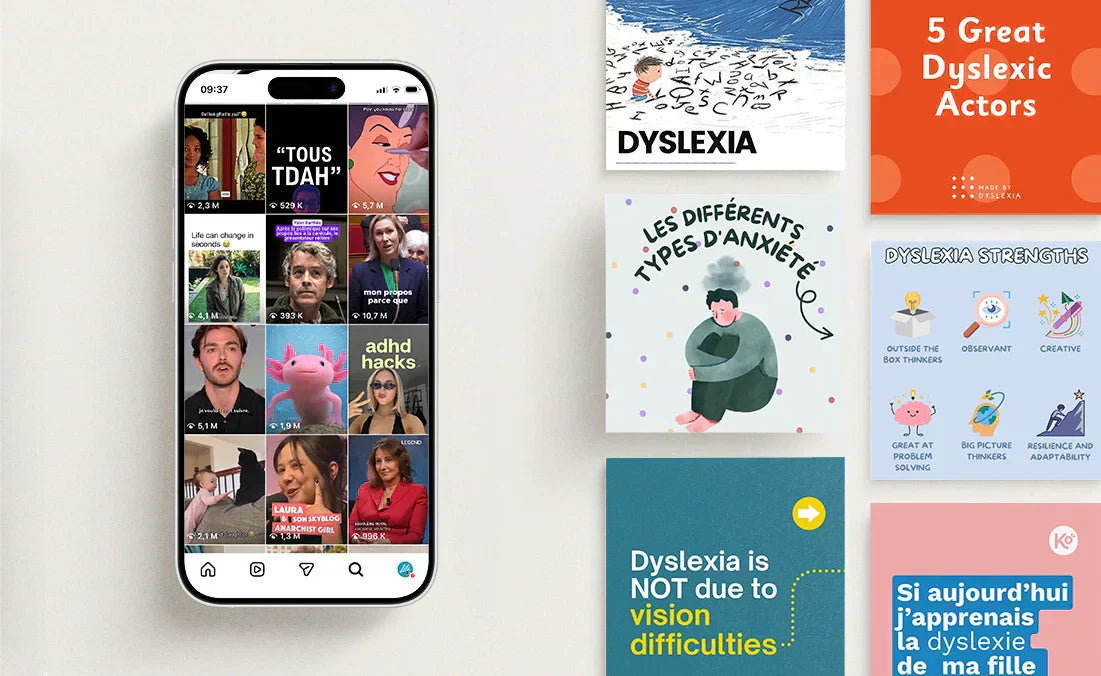
Dyslexia is still too often discussed only in terms of difficulty: difficulty reading, spelling, memorising information or keeping up in the classroom.
Yet dyslexia is far more complex than a list of challenges. It can also involve a different way of processing information, solving problems, making connections and approaching the world. Many dyslexic people develop strong visual thinking, creativity, intuition and an ability to see the bigger picture.
Instagram has become an important space for sharing these experiences. Alongside personal stories, there are now expert-led accounts, advocacy organisations and family-focused communities offering reliable information and practical support.
The challenge is knowing which accounts are genuinely useful.
For this selection, we chose five English-language Instagram accounts that each bring a distinct perspective: positive representation, expert guidance, community awareness, lived experience and family support.
Together, they offer a richer and more balanced understanding of dyslexia.
1. Made By Dyslexia: changing the way we think about dyslexia
Instagram Account: @madebydyslexia

Made By Dyslexia is one of the most influential organisations working to change the global conversation around dyslexia.
Its central message is clear: dyslexia should not be understood only as a learning difficulty. It is also associated with a distinctive set of thinking skills that can be valuable at school, at work and in wider society.
The organisation often uses the term Dyslexic Thinking to describe strengths commonly associated with dyslexic minds. These may include creativity, visual reasoning, problem-solving, storytelling, empathy, imagination and the ability to connect ideas in unexpected ways.
Through campaigns, interviews and educational content, the account highlights the experiences of dyslexic entrepreneurs, artists, business leaders, students and professionals. These stories help challenge the idea that dyslexia must limit ambition or achievement.
Made By Dyslexia also places strong emphasis on education and employment. Its content encourages schools to recognise dyslexic strengths rather than focusing exclusively on weaknesses. It also calls on employers to create environments in which different thinking styles can be understood and valued.
This wider perspective is particularly important for young dyslexic people. Seeing successful adults speak openly about dyslexia can help them imagine a future that is not defined by school difficulties.
Why follow Made By Dyslexia?
Follow this account for a more positive and ambitious view of dyslexia.
Its content does not ignore the challenges that dyslexic people may face. Instead, it places those challenges within a broader picture that also includes talent, potential and different ways of thinking.
Its main contribution is to change perceptions and highlight the value of Dyslexic Thinking.
2. British Dyslexia Association: reliable guidance and expert information
Instagram: @bdadyslexia

The British Dyslexia Association is a leading source of information and support on dyslexia in the United Kingdom.
Its Instagram account covers a wide range of topics, including the identification of dyslexia, educational support, workplace inclusion, assessments, reasonable adjustments and public awareness.
Unlike more personal or inspirational accounts, the British Dyslexia Association offers a structured and institutional perspective. This makes it a useful reference point for parents, educators, employers and dyslexic adults looking for clear, evidence-informed guidance.
The account also helps followers understand that dyslexia can affect people throughout their lives. Although the signs are often first noticed at school, the need for support does not necessarily disappear in adulthood.
A dyslexic employee may, for example, benefit from written instructions presented more clearly, access to assistive technology, extra preparation time or a different way of organising tasks. The account regularly contributes to conversations about how these adjustments can improve inclusion without lowering expectations.
For families, the British Dyslexia Association can also provide a useful framework for understanding the assessment process and the different forms of support that may be available.
Why follow the British Dyslexia Association?
Follow this account for reliable, structured information from a recognised dyslexia organisation.
It can help followers move beyond general awareness and develop a more precise understanding of identification, support and inclusion.
Its main contribution is to provide expert guidance and an authoritative perspective on dyslexia.
3. Succeed With Dyslexia: celebrating achievement and raising awareness
Instagram Account: @succeedwithdyslexia

Succeed With Dyslexia focuses on awareness, visibility and success.
The account shares encouraging content about dyslexic people, promotes greater understanding of learning differences and highlights stories that challenge outdated assumptions.
Its tone is generally positive and accessible. This makes its posts easy to engage with and share, particularly for people who are only beginning to learn about dyslexia.
The account also provides an important counterbalance to narratives that present dyslexia only as a problem to be corrected. By showcasing achievement, resilience and alternative ways of thinking, it helps widen the public understanding of what dyslexic people can do.
That does not mean presenting dyslexia as a “superpower” in every situation. Dyslexic people may encounter very real difficulties, particularly when environments are not adapted to their needs. But success stories can still play an important role.
They can reduce stigma, build confidence and help children and adults see that dyslexia does not determine the limits of their future.
Succeed With Dyslexia also supports wider awareness campaigns and encourages schools, workplaces and communities to become more inclusive.
Why follow Succeed With Dyslexia?
Follow this account for uplifting, shareable content that helps challenge stereotypes.
It is especially useful for families and educators looking for positive examples to share with dyslexic children and teenagers.
Its main contribution is to celebrate dyslexic achievement and help shift public perceptions.
4. The Dyslexic Movement: hearing directly from lived experience
Instagram: @the_dyslexic_movement

The Dyslexic Movement brings a more personal and directly lived perspective to this selection.
The account is run by Zoe-Jane Littlewood, who speaks openly about her own experience of dyslexia. Her content combines personal reflections, awareness-raising and practical observations about navigating education, work and everyday life as a dyslexic person.
This kind of first-person perspective is essential.
Professional and institutional information can explain what dyslexia is, but lived experience shows what it can feel like. It can reveal the frustration of being misunderstood, the emotional impact of repeated difficulties and the strategies people develop over time.
Personal accounts can also help challenge the idea that all dyslexic people have the same profile.
Dyslexia can affect reading, spelling, organisation, memory or processing speed in different ways. The impact may also vary depending on the situation, the level of support available and the person’s own strengths.
By speaking from experience, The Dyslexic Movement adds nuance to the conversation. It reminds followers that dyslexic people should not only be discussed by experts or institutions; they should also be heard directly.
Why follow The Dyslexic Movement?
Follow this account to better understand the human and emotional realities of dyslexia.
Its personal tone makes complex issues more relatable and can help dyslexic adults feel recognised in experiences they may have struggled to explain.
Its main contribution is to centre the voice of someone with direct lived experience of dyslexia.
5. Dyslexia Mom Life: supporting parents through the family journey
Instagram: @dyslexiamomlife

Dyslexia Mom Life focuses primarily on the experiences of mothers and families supporting a dyslexic child.
For many parents, the path from first concerns to assessment and appropriate support can feel overwhelming. They may notice that their child is working extremely hard but still struggling to read, spell or complete homework. They may also face uncertainty when communicating with schools or deciding which support to seek.
The account speaks directly to these realities.
Its content addresses the emotional side of parenting a dyslexic child as well as the practical challenges. It offers encouragement, shared experiences and reminders that families are not alone.
This family-centred perspective matters because dyslexia can affect more than academic performance. Repeated difficulties may influence a child’s confidence, motivation and relationship with school.
Parents often play a central role in protecting that confidence. They may need to advocate for adjustments, explain the child’s needs to others and help separate learning difficulties from intelligence.
A supportive online community cannot replace professional assessment or specialist teaching, but it can make the journey feel less isolating.
Why follow Dyslexia Mom Life?
Follow this account for a warm, family-focused perspective on supporting a dyslexic child.
It is particularly relevant for parents looking for encouragement, relatable experiences and a stronger sense of community.
Its main contribution is to represent the realities and needs of families raising dyslexic children.
Five accounts, five complementary perspectives
These five accounts were selected because they do not all approach dyslexia in the same way.
Made By Dyslexia promotes a global, strengths-based vision of Dyslexic Thinking.
The British Dyslexia Association provides structured, expert information on identification, support and inclusion.
Succeed With Dyslexia raises awareness by celebrating achievement and challenging limiting assumptions.
The Dyslexic Movement brings an essential first-person perspective grounded in lived experience.
Dyslexia Mom Life focuses on the emotional and practical realities faced by parents and families.
Together, they create a more complete picture of dyslexia: one that includes challenges, strengths, rights, personal experiences and everyday support.
How to use dyslexia content on Instagram wisely
Instagram can be a valuable starting point for discovering resources, hearing personal stories and learning about new approaches.
However, social media content should always be approached with some perspective.
No single post can fully reflect the complexity of dyslexia. Each dyslexic person has an individual profile, and a strategy that works well for one child or adult may not be suitable for another.
It is also important to distinguish between awareness content, personal experience and professional advice.
A first-person account may provide valuable insight without offering clinical guidance. An institutional account may share reliable information without reflecting every individual experience. Both can be useful, provided their role is understood.
When reading or writing difficulties are persistent, an appropriate professional assessment remains essential. Qualified specialists can help identify specific needs and recommend suitable forms of support.
Instagram can then play a complementary role: helping families ask better questions, discover tools designed to improve reading comfort for people with dyslexia, understand terminology and connect with a wider community.
Why representation matters
The way dyslexia is represented has a real impact.
When dyslexic children hear only about what they find difficult, they may begin to associate learning with failure. When adults repeatedly encounter misunderstanding at work, they may hide their needs rather than ask for support.
More balanced representation can help change this.
It can show that needing a different approach does not mean lacking ability. It can remind educators and employers that accessibility benefits everyone. It can also help dyslexic people recognise that they are part of a much wider and diverse community.
Accounts such as Made By Dyslexia, the British Dyslexia Association, Succeed With Dyslexia, The Dyslexic Movement and Dyslexia Mom Life contribute to that change in different ways.
One post may provide a practical insight. Another may offer reassurance. Another may challenge a stereotype that has existed for decades.
Together, these conversations help create a more informed and inclusive understanding of dyslexia—one in which difficulties are acknowledged, support is taken seriously and different ways of thinking are given the recognition they deserve.