
📌 À retenir
✔ La dyslexie ne se “corrige” pas : elle se comprend et se navigue. Le podcast montre pourquoi sortir de la logique de compensation change profondément le parcours des personnes dys.
✔ Les profils dys développent souvent des forces spécifiques. Pensée globale, créativité, intuition, capacité à relier les idées : autant d’atouts encore trop peu valorisés.
✔ L’inclusion n’est pas un geste de bienveillance, c’est un levier collectif. Mieux accompagner les troubles dys, c’est permettre à chacun d’exprimer pleinement son potentiel.
Qu'est-ce que les troubles dys ?
Avant d'entrer dans le vif du sujet, un point de repère utile. Les troubles dys sont des troubles spécifiques de l'apprentissage liés à des modifications d'une ou plusieurs fonctions cérébrales : attention, mémoire, langage, fonctions exécutives. Les principaux troubles dys :
- dyslexie (lecture et langage écrit)
- dysphasie (langage oral)
- dyspraxie (coordination et gestes)
- TDAH (attention et concentration)
Un point essentiel, et souvent méconnu : ces troubles surviennent chez des enfants dont l'intelligence est normale, voire supérieure à la moyenne. Ils se distinguent nettement des difficultés d'apprentissage générales, qui peuvent souvent être corrigées par un soutien ciblé. Les troubles dys, eux, nécessitent un accompagnement spécifique, qui aide l'enfant à développer ses propres stratégies pour naviguer avec son fonctionnement particulier et non à le corriger. Entre 8 et 10 % des enfants scolarisés sont concernés. Des signes peuvent alerter parents et enseignants : difficultés persistantes à lire, à écrire ou à mémoriser, problèmes de concentration, fatigue dans les tâches quotidiennes, ralentissement dans le travail autonome. Si ces signaux se cumulent, une évaluation multidisciplinaire est recommandée, auprès de neuropédiatres, neuropsychologues, orthophonistes ou psychomotriciens.
Six épisodes pour déconstruire un regard
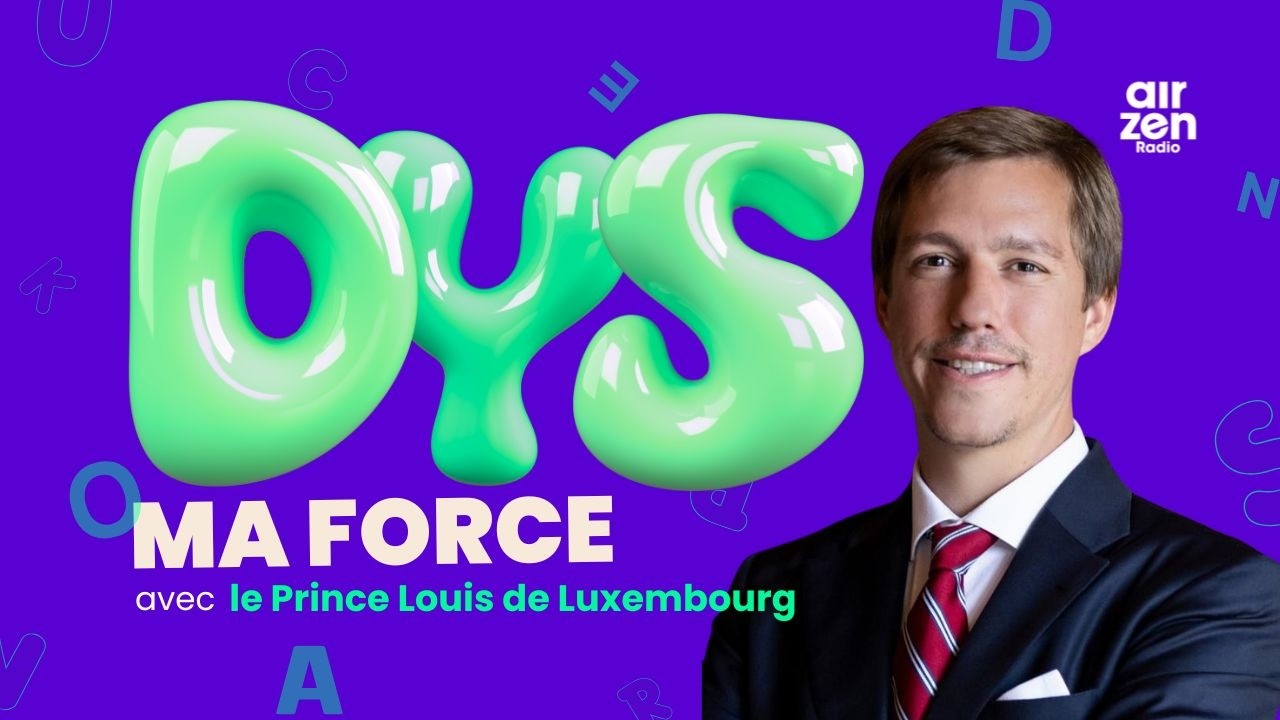
Le podcast Dys : ma force s'ouvre comme un conte : "Il était une fois un petit prince… et des millions d'autres comme lui." Derrière la formule poétique se cache une réalité bien concrète : des millions d'enfants et d'adultes qui pensent autrement, apprennent autrement, et se heurtent quotidiennement à un monde conçu pour un seul type de cerveau. La série se déploie en six épisodes narratifs et immersifs, où la voix du Prince Louis de Luxembourg sert de fil rouge, entremêlée à celles d'une constellation d'experts. Dès le premier épisode, "Ma vie en dys", le ton est donné : Béatrice Sauvageot, orthophoniste et chercheuse en neurosciences, le Dr Michèle Mazeau, médecin de rééducation et autrice de Les troubles des apprentissages pour les nuls, ou encore Nathalie Groh, présidente de la Fédération Française des DYS, viennent poser les bases scientifiques et humaines du sujet. "Ils ont la sensation d'être dans un autre monde", confie Béatrice Sauvageot. Une sensation que le Prince Louis confirme avec une lucidité désarmante : "On sent qu'on n’est pas bête. Mais on est constamment mis face à nos échecs, et notre différence se mesure dans le regard des autres." Le deuxième épisode, "Et si ce n'était pas une anomalie ?", enfonce le clou scientifique : les cerveaux dys n'activent pas les mêmes circuits que les cerveaux neurotypiques, mais développent d'autres connexions, souvent plus riches et plus complexes. Diagnostiquer ne vise pas à étiqueter, rappellent les experts, mais à permettre des adaptations pédagogiques. L'épisode 3, "L'école, ce champ des possibles ?", interroge un système scolaire encore trop rigide face aux neuroatypies, quand l'épisode 4, "Un autre cerveau, un autre monde", célèbre les forces spécifiques des profils dys : pensée en 3D, créativité, intuition, empathie, capacité à relier des idées distantes. "Être dys, ce n'est pas être moins capable, c'est être autrement capable", résume le Dr Mazeau. Sabrina Menasria, de la Neurodiversity Alliance, va plus loin encore : des études sérieuses démontrent de réelles compétences en matière d'entrepreneuriat et de capacité à fédérer. L'épisode 5, "Le temps des solutions", fait le tour des outils concrets disponibles : l'application Poppins pour la rééducation ludique, les livres enrichis de Mobidys, les sous-titres inclusifs DysTitle déployés par Canal+, ou encore le système Orasis Ear d'analyse des mouvements oculaires. "Ce qui aide les enfants dys aide bien souvent tous les enfants", y rappelle le Prince Louis. Enfin, l'épisode 6, "Demain, une société bilexique ?", projette en 2041 une école où chaque enfant choisit comment apprendre. Béatrice Sauvageot y avance une hypothèse aussi belle qu'ambitieuse : remplacer le mot "trouble" par celui de "bilexie", soit la capacité de parler sa langue neurologique tout en comprenant celle des autres. Un renversement de perspective qui dit mieux que n'importe quel discours à quel point le changement de regard est fondamental.
Ne pas compenser. Naviguer.
Quand on lui demande si, en tant qu'adulte, il rencontre encore des difficultés liées à la dyslexie, la réponse du Prince Louis est révélatrice du chemin parcouru :
"On utilise les forces, on apprend à naviguer. Surtout pas à compenser, ou essayer de compenser le moins possible. Parce que la compensation est un poids gigantesque sur les dyslexiques, et la raison pour laquelle il y a tellement de burnout chez eux."
Ce basculement, de la compensation à la navigation, est au cœur de ce qu'il s'efforce de transmettre dans son activité de coaching pour adultes dyslexiques. Car compenser, c'est s'épuiser à faire comme les autres, à masquer ses différences, à courir après une normalité qui ne sera jamais la sienne. Naviguer, c'est apprendre à lire son propre cerveau, identifier ses forces, et les mobiliser là où elles créent de la valeur. C'est précisément pour cela qu'il a choisi de se concentrer sur le public adulte, convaincu qu'il existe un angle mort béant : "Il y a beaucoup autour de l'enfance. Il n'y a rien du tout autour des adultes. Je vois une niche où il y a un vrai besoin." À travers son activité d'accompagnement, il aide des profils dys à comprendre leur fonctionnement cognitif et à en faire un levier dans l'univers professionnel, notamment dans l'écosystème des start-up, où la pensée globale et la créativité sont des atouts précieux.
Complexifier pour comprendre, simplifier pour transmettre
Une des idées les plus contre-intuitives du podcast Dys : ma force tient en une formule paradoxale que le Prince Louis énonce avec clarté :
"Complexifier la chose pour la comprendre, et la simplifier pour la transmettre."
Le cerveau dyslexique pense en réseau, en images, en systèmes. Il comprend mieux une forêt entière qu'un arbre isolé. Lui présenter un problème de manière linéaire et fragmentée, c'est lui retirer sa boussole naturelle. En revanche, lui offrir d'emblée la complexité, les connexions entre les éléments, c'est lui parler sa langue. La seconde partie de la formule est tout aussi importante. Car ce que le Prince Louis pointe avec acuité, c'est que la difficulté du dyslexique n'est pas une difficulté de compréhension : "Ce n'est pas un problème de compréhension. C'est un problème de transmission." Il comprend profondément, intensément, globalement. Apprendre à traduire cette richesse intérieure en langage accessible est une compétence qui se travaille et l'un des axes centraux de son activité de coaching.
Croire plutôt que savoir : la puissance d'une posture ouverte
Voilà peut-être l'idée la plus philosophique du podcast, et l'une des plus précieuses. Le Prince Louis fait une distinction subtile mais essentielle entre savoir et croire :
"Si on sait quelque chose, on le met dans une boîte et on arrête d'y réfléchir. Il faut toujours croire, parce que quand on croit, on garde les yeux ouverts sur le sujet, et on veut toujours apprendre plus sur ce sujet pour continuer à être dans cette croyance, ou être flexible, pour arriver à une compréhension plus profonde encore."
Lorsqu'on sait, on ferme. On classe. On range. Lorsqu'on croit, on reste ouvert, on continue à chercher, à questionner, à approfondir. Selon lui, les personnes dyslexiques ont naturellement recours à cette posture exploratoire, non par manque de rigueur, mais parce que leur rapport au monde est fondamentalement curieux et non linéaire. C'est précisément cette disposition d'esprit qui leur permet d'atteindre des niveaux de compréhension d'une profondeur inhabituelle.
L'inclusion : utile, pas seulement gentille
C'est la phrase qui résume le mieux l'ambition politique du podcast :
"L'inclusion scolaire, l'inclusion sociale… ce n'est pas juste gentil. C'est utile. C'est bête de laisser des gens de côté et de pas les utiliser, alors qu'on a besoin d'enrichir la société."
Les six épisodes de Dys : ma force le démontrent avec constance : les cerveaux dys ne dysfonctionnent pas, ils fonctionnent autrement. Leur pensée en 3D, leur intuition, leur créativité, leur flexibilité intellectuelle en font, selon Sabrina Menasria, de véritables "sentinelles" dans les organisations : des profils qui challengent le collectif, repèrent ce qui cloche, et innovent là où d'autres reproduisent. Le Prince Louis pousse la réflexion jusqu'à formuler un souhait simple et apaisé pour l'avenir:
"Je ne crois pas qu'on ait besoin que tout le monde comprenne tout sur tout le monde. J'ai envie que tout le monde accepte tout le monde."
La Fondation Henri-Maria Teresa : de la conviction à l'action
Derrière le podcast, il y a une institution. La Fondation Henri-Maria Teresa, présidée par S.A.R. la Grande-Duchesse Maria Teresa de Luxembourg, traduit ces convictions en engagements concrets. Avec l’implication active du Prince Louis, la Fondation a déjà contribué de manière significative à améliorer la prise en charge des troubles de l’apprentissage. Parmi ses initiatives les plus significatives : la création en mars 2026 du premier forum dédié à la dyslexie chez l’adulte, un espace encore trop rare, alors que la grande majorité des ressources et des dispositifs d'accompagnement restent concentrés sur l'enfance. Car si le dépistage précoce est crucial, des milliers d'adultes vivent avec une dyslexie non diagnostiquée ou tardivement reconnue, sans avoir jamais eu accès aux outils pour la comprendre et la valoriser. Le travail de la Fondation, comme celui du podcast, vise à combler ce vide et à faire de l'inclusion une réalité à tous les âges de la vie. "La souffrance doit arrêter. Il faut les mettre au centre, leur donner leur place", conclut le Prince Louis. Pas comme un vœu pieux. Comme une feuille de route.
Pourquoi ce podcast résonne pour nous
Chez Lili for Life, nous partageons cette conviction exprimée par le Prince Louis : les technologies doivent servir à réduire l'effort cognitif des personnes dyslexiques. Comme il le dit : "L'intelligence artificielle sera absolument révolutionnaire pour les dyslexiques, car elle prendra en charge à l'avenir une grande partie de ce avec quoi ils sont aux prises." Quand les tâches épuisantes sont déléguées à la technologie, l'énergie libérée peut enfin être consacrée à ce pour quoi le cerveau dys excelle naturellement : comprendre en profondeur, relier les idées, créer, innover. C'est exactement l'ambition de la technologie Lili. En réduisant la fatigue cognitive liée à la lecture, elle permet aux personnes dyslexiques de consacrer leurs ressources mentales à ce pour quoi leur cerveau est particulièrement doué : relier les idées, penser en profondeur, trouver des solutions que les autres ne voient pas… et pourquoi pas, accéder au plaisir de la lecture.
Dys : ma force est disponible sur toutes les plateformes de podcasts. L'interview intégrale du Prince Louis de Luxembourg est accessible sur la chaîne YouTube d'AirZen Radio. Le podcast est une coproduction originale AirZen Radio et la Fondation Henri-Maria Teresa.