When a state chooses to honor a public figure, the gesture always goes beyond individual recognition.
It says something about an era.
It says something about the values a society decides to highlight.
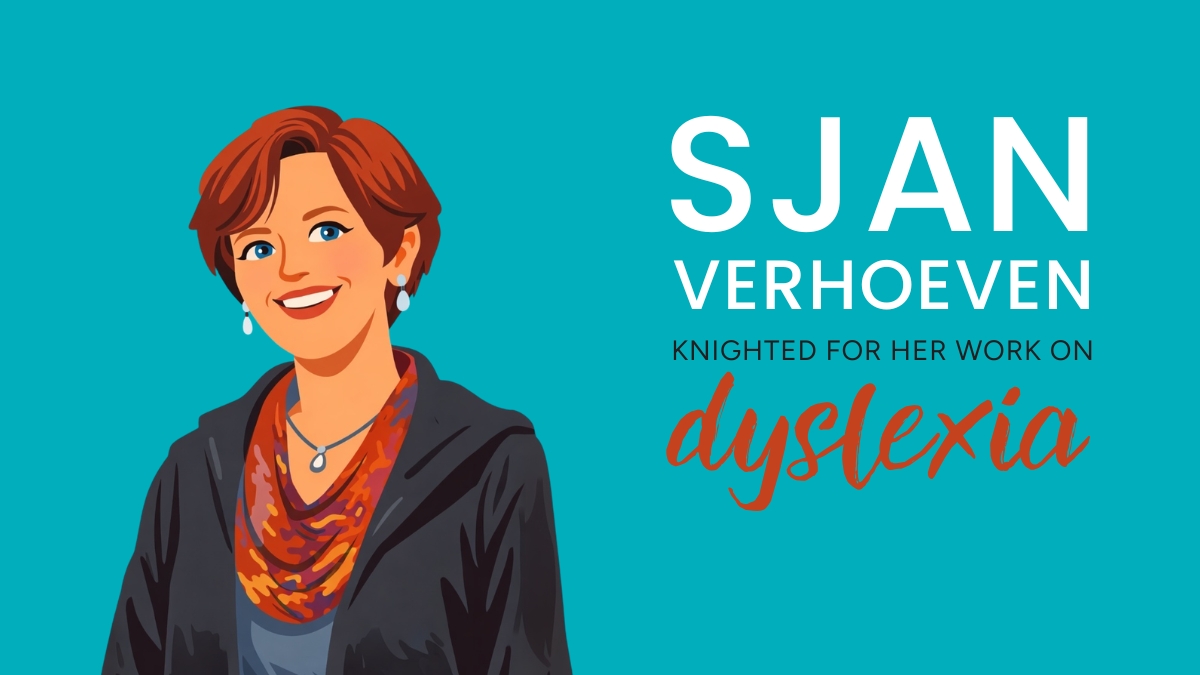
In 2017, Dutch author Sjan Verhoeven was appointed Ridder in de Orde van Oranje-Nassau (Knight in the Order of Orange-Nassau), a royal distinction granted by decree signed by King Willem-Alexander. Although the medal was presented to her in Amsterdam during the traditional Lintjesregen, the decision itself belongs to the Dutch state and its national order of chivalry.
This appointment is not simply a literary award.
It officially recognizes a long-term commitment to supporting dyslexic adults and, more broadly, learning differences.
Long perceived as an isolated school difficulty — often confined to childhood — dyslexia now sits at the center of broader conversations:
educational inclusion, fairness in assessment systems, neurodiversity, professional performance, and social innovation.
The issue is no longer purely educational.
It is cultural, institutional, and economic.
That a European monarchy would honor someone engaged in this field marks an important symbolic step. The gesture places dyslexia among causes acknowledged as serving the public interest. It signals that recognizing learning differences is no longer a peripheral struggle, but a societal matter.
But who exactly is Sjan Verhoeven?
Why did the Dutch state consider her work worthy of a royal honor?
And above all, what does this official recognition reveal about the changing perception of dyslexia and neurodiversity — in Europe and beyond?
Whi is Sjan Verhoeven?
Sjan Verhoeven is a Dutch author and speaker who has long been involved in supporting adults with dyslexia. She is particularly known for her work in awareness-raising, training, and coaching around learning differences.
Through her writing, conferences, and nonprofit involvement, she has helped bring visibility to a reality that was long underestimated: living, learning, and building a professional path with dyslexia.
Her approach goes beyond describing the condition.
It is rooted in an educational and societal perspective aimed at explaining, destigmatizing, and reshaping how dyslexia is perceived.
In her talks, dyslexia is not presented as an intellectual weakness — because it is not — but as a different way of processing written information. A difference that can create obstacles, especially in standardized environments, yet can also reveal specific strengths when learning and working conditions are adapted.
This perspective aligns with a broader international shift: moving from a deficit-focused model to one based on environmental adaptation and recognition of neurodiversity.
In the Netherlands, where educational policies emphasize inclusion and practical accommodations, this vision resonates strongly.
Sjan Verhoeven is therefore not only an author. She has become an advocate for the recognition of adults with dyslexia, notably through:
- her work as a trainer and coach
- her volunteer involvement in associations
- the organization of conferences and events about dyslexia
- her public speaking promoting a more positive perception of the condition
It is this sustained commitment — educational, social, and cultural — that led Dutch authorities to appoint her Knight in the Order of Orange-Nassau in 2017.
Why did the Dutch monarchy decorate the Dutch author?
In the Netherlands, royal honors are not awarded lightly. They recognize a significant and lasting contribution to Dutch society — whether cultural, scientific, educational, or social.
Sjan Verhoeven’s appointment is part of this tradition.
It does not merely reward a writing career. It recognizes a sustained commitment to supporting dyslexic adults and advancing the recognition of learning differences.
By honoring a person engaged in this field, the Dutch state sends a clear message: dyslexia is not a marginal issue. It affects the full participation of thousands of citizens in education, professional life, and society.
This recognition rests on several dimensions.
1. A cultural contribution
Through her books, conferences, and public speaking, Sjan Verhoeven has helped bring dyslexia into the Dutch public conversation. Her work contributes to reshaping the collective narrative — moving from a focus on difficulty toward an approach centered on support and empowerment.
2. An educational and professional commitment
Her work as a trainer and coach for dyslexic adults aims to strengthen autonomy and confidence. Her approach is practical: providing tools, highlighting strengths, and supporting integration into higher education and the workplace.
Rather than claiming she transformed the education system, it is more accurate to say she helped shift perceptions and support individual trajectories.
3. A societal impact
The distinction highlights the growing importance of learning differences in public policy and contemporary discussions around neurodiversity.
In an international context where inclusion and equity are increasingly central, this appointment goes beyond the national level. It places dyslexia within a broader conversation about equal opportunity and adapting environments.
When a state officially recognizes engagement in favor of dyslexic individuals, it publicly legitimizes the fight against stigma. It affirms that recognizing learning differences is a collective responsibility.
This symbolic dimension matters.
It marks a shift from a perspective focused on individual difficulty toward a more structural approach: adapting systems rather than correcting individuals.
What this reveals about the changing societal perception of dyslexia
For decades, dyslexia was primarily viewed through the lens of academic difficulty.
A “slow” student.
A child “not trying hard enough.”
An adult “uncomfortable with written language.”
This deficit-focused view of dyslexia has deeply shaped individual life paths across generations. It often led to the invisibility of specific needs and, in some cases, lasting stigma.
Yet available data reminds us that dyslexia does not affect a marginal minority.
From deficit to difference
Sjan Verhoeven’s nomination fits within this broader movement.
It does not deny the real challenges dyslexia can create.
But it reflects a wider cultural shift: dyslexia is no longer viewed solely as an individual obstacle to correct. It is increasingly understood as a different way of processing written information, requiring appropriate accommodations.
This shift lies at the heart of the international neurodiversity movement.
Rather than defining learning disorders exclusively as pathologies, many researchers, educators and institutions now speak of learning differences — different ways of learning and processing information.
This change in vocabulary is not trivial.
It does not mean the difficulties disappear.
It means responsibility no longer rests solely on the individual.
It extends to education systems, organizations and workplaces.
Adapting the environment becomes a matter of equity.



An institutional recognition that normalizes the issue
When a monarchy honors a person committed to dyslexia advocacy, it helps normalize the topic in the public sphere.
It implicitly acknowledges that:
- dyslexia affects a significant portion of the population,
- the difficulties encountered are not due to a lack of intelligence or effort,
- public policies have a role to play in reducing inequalities in access to learning and professional performance.
This type of distinction contributes to reshaping the collective narrative.
Dyslexia is no longer seen solely as an individual difficulty.
It becomes an issue of educational equity, professional inclusion and, more broadly, social innovation.
An increasingly international conversation
This shift is not limited to the Netherlands.
In the United States, the United Kingdom, Scandinavia and France, several developments converge:
- expansion of school and university accommodations,
- growth in scientific research on specific learning disorders,
- greater visibility of public figures with dyslexia,
- emergence of technologies designed to improve reading accessibility.
In this context, Sjan Verhoeven’s distinction acts as a cultural marker.
It shows that dyslexia is now fully recognized as a legitimate subject of institutional recognition.
And it confirms a deeper trend:
modern societies are beginning to view inclusion not as a favor granted to a few, but as a collective responsibility.
How the Netherlands approaches learning differences
The Netherlands is often cited among European countries that have structured their education policy around a progressive inclusion model.
Regarding learning differences — including dyslexia — the Dutch approach follows a simple principle: identify early, support concretely, and adapt the learning environment.
Early and structured identification
The Dutch education system places strong emphasis on identifying learning difficulties from primary school.
Observation and assessment protocols help detect persistent reading and writing difficulties. The goal is not to label, but to prevent.
The earlier needs are identified, the more naturally adjustments can be integrated into the student’s learning path.
This preventive approach aims to avoid long-term barriers — academic but also psychological (loss of confidence, demotivation, avoidance of written tasks).
Adaptations integrated into the educational framework
In the Netherlands, dyslexia support is not solely medical. It is educational and functional.
Possible accommodations include:
- extra time during exams,
- adapted digital tools,
- differentiated learning materials,
- specialized support when necessary.
The central idea is not to “normalize” the student.
It is to adjust the learning framework to remove unnecessary obstacles.
This approach aligns with European inclusive education principles:
it is not only the student who must adapt to the system — the system must also evolve to ensure equity.
A question that goes beyond school
Beyond the classroom, learning differences are increasingly integrated into a broader reflection on social participation.
In the Netherlands, dyslexia is discussed in relation to:
- academic achievement,
- access to higher education,
- professional integration,
- technological innovation and digital accessibility.
This transversal perspective is essential.
It prevents dyslexia from being confined to a strictly academic category and places it within a life-course perspective.
An enlightening international comparison
If we compare:
- In the United States, legal frameworks (IEP, 504 Plans) strongly structure accommodations and formalize student rights.
- In France, programs such as PAI or PPS regulate school adaptations.
- In the Netherlands, the approach combines educational pragmatism, structured measures and broader societal recognition.
The distinctive element lies less in the tools themselves than in how the topic is integrated into public discourse.
In this context, Sjan Verhoeven’s nomination takes on particular significance.
It occurs in a country where learning differences are already embedded in a wider educational and social reflection.
Institutional recognition does not create the dynamic — it reinforces it.
It confirms that learning differences are not only an educational matter.
They are part of a broader vision of equity, accessibility and educational modernity.
What this reveals about a global shift in paradigm
Sjan Verhoeven’s appointment to the Order of Orange-Nassau is not an isolated event.
It reflects a broader movement: a gradual transformation in how societies understand dyslexia and, more widely, learning differences.
For a long time, the dominant response followed an individual logic: identify the difficulty, provide remediation, attempt correction.
Today, the center of gravity is shifting.
From correction to adaptation
The traditional paradigm focused on remediation:
- diagnose,
- remediate,
- compensate case by case.
The emerging paradigm focuses on adaptation:
- adjust learning environments,
- integrate accessibility into tool design,
- rethink systems rather than correct individuals.
This shift is structural.
It means we no longer measure only a person’s ability to adapt to an existing framework, but also the framework’s ability to reduce barriers.
The institutional recognition granted to someone engaged in dyslexia advocacy fits into this evolution: it legitimizes the idea that adapting environments is a collective responsibility.
A movement beyond borders
From the United States to Northern Europe, the conversation around neurodiversity is gaining visibility:
- increased institutional recognition,
- media visibility of people with dyslexia,
- growing scientific research on reading and visual processing,
- integration of accessibility into education policies and corporate strategies.
This reflects a gradual awareness.
Inclusion is not only a moral principle.
It is an educational, economic and societal issue.
Enabling everyone to fully mobilize their abilities is not symbolic.
It is a condition for collective performance.
Innovation as a lever for equity
In a world where digital text structures school, university and work, the reading environment becomes central.
Adapting pedagogy alone is no longer sufficient.
Tools themselves must also be adapted.
Improve visual comfort.
Reduce cognitive fatigue.
Enhance on-screen reading stability.
These aspects, once considered secondary, are now part of a broader reflection on accessibility and equity.
The Dutch royal distinction sends a strong cultural signal. But real change in daily life depends on concrete solutions.
Creating the conditions for smoother, more sustainable reading is not about giving an advantage. It is about correcting a structural imbalance.
This is precisely where innovations designed for readers with dyslexia fit in.
They embody, in practice, this global paradigm shift: moving from symbolic recognition to operational adaptation.
Understanding is a first step. Adapting the environment is another.
Today, research and innovation make it possible to act directly on reading comfort for people with dyslexia, especially in digital environments where written content is everywhere.
At Lili for Life, we develop solutions designed to improve visual stability and reduce reading fatigue, both at school and at work.
👉 Discover how technology can improve the reading experience: